AI Assistant Development.
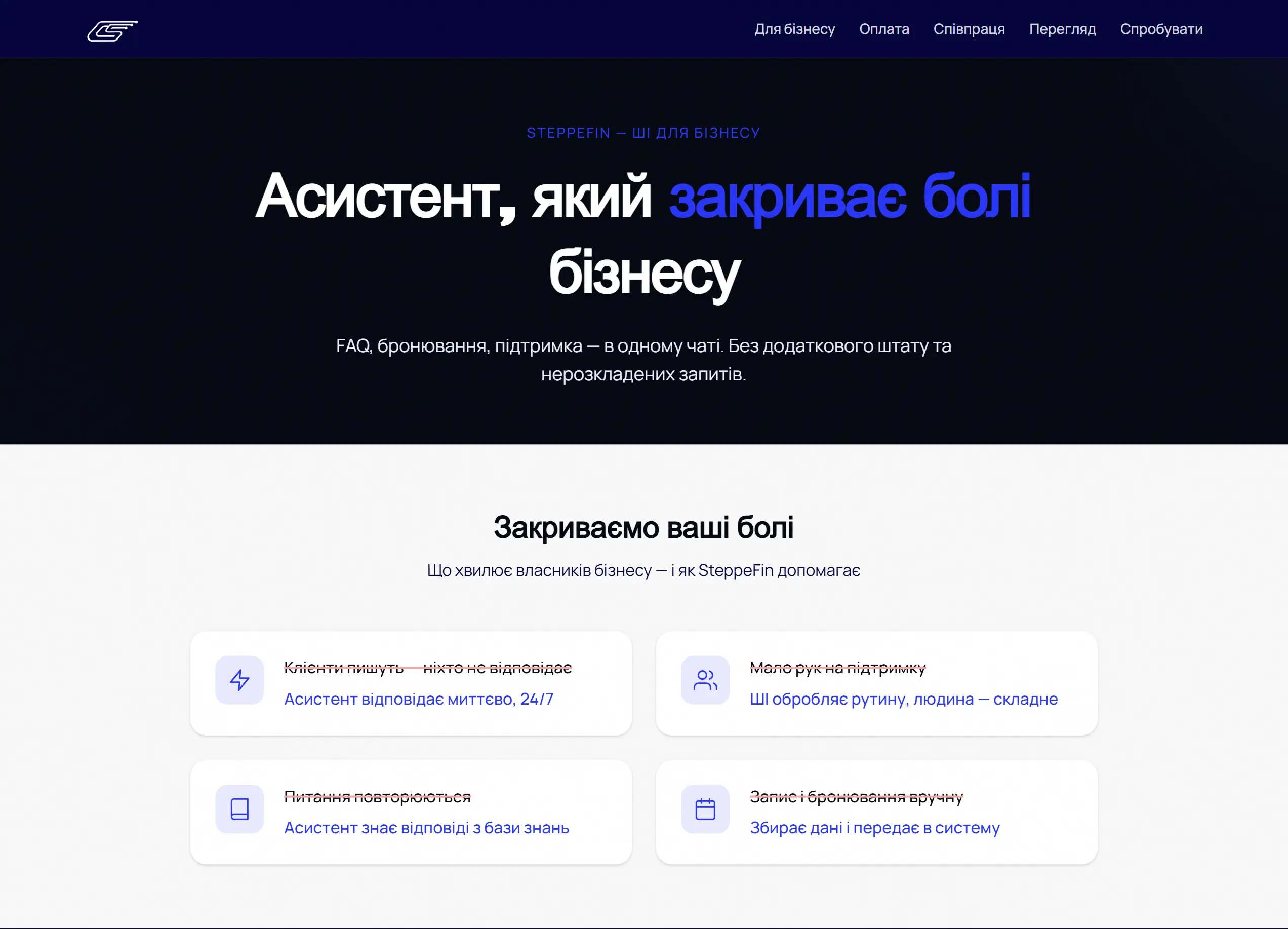
We build AI assistants that live inside your product and do useful work: answer questions from your documentation and data, guide users through flows, trigger actions through tools and APIs, and hand off to a human when confidence is low. SteppeFin, a finance platform with integrated chat assistants, is one example; the same approach applies to support, operations and internal knowledge tools.
Discuss your productWho this is for.
- 01
Product teams adding an assistant to a SaaS, fintech or marketplace product without turning it into a research project
- 02
Companies with large support or operations volume that want an assistant grounded in their own data
- 03
Teams that tried a no-code chatbot and hit limits in accuracy, integration or control
What's included
- 01
Use-case discovery and a measurable definition of "good" answers
- 02
Retrieval over your documents and databases with chunking, embeddings and access control
- 03
Tool use: calling your APIs for lookups, actions and transactions with confirmations
- 04
Conversation UI in your product with streaming, citations and feedback controls
- 05
Guardrails: input and output policies, PII handling, rate and cost limits
- 06
Evaluation harness with test sets, regression checks and human review
- 07
Observability: traces, costs, quality dashboards and escalation analytics
- 08
Model routing across providers or self-hosted models where data residency matters
How we build it.
Most assistant projects fail on evaluation, not on prompts. We start by collecting real questions and defining what a correct answer looks like, then build retrieval and tools against that test set and measure every change. The assistant is a normal software component with typed interfaces to your systems, logged like any other service, and deployable without a model lock-in.
- 01
Evaluation set first; prompts, retrieval and models are tuned against it
- 02
Retrieval honours your permission model, so users only see what they are allowed to see
- 03
Actions go through your existing APIs with explicit confirmation for anything irreversible
- 04
Provider-agnostic model layer with fallback and cost controls
Scope, timeline and budget.
Ranges are based on recent projects. After a discovery call we send a fixed estimate for the first milestone.
Assistant pilot
- Timeline
- 6–8 weeks
- Budget
- from 25k USD
One use case, retrieval over your data, embedded chat UI, evaluation set and quality report.
Production assistant
- Timeline
- 3–5 months
- Budget
- 60–120k USD
Multiple use cases, tool use and actions, guardrails, observability, human handoff, rollout to all users.
Team extension
- Timeline
- ongoing
- Budget
- monthly
AI and backend engineers embedded in your team to run and extend assistants in production.
Frequently asked questions.
01Which models do you use?
OpenAI, Anthropic, Google and open-weight models, chosen per use case based on quality, latency, cost and data-residency requirements. The integration layer lets you switch or combine providers later.
02How do you prevent hallucinations?
Grounding answers in retrieved sources with citations, restricting the assistant to its domain, confidence thresholds with human handoff, and a regression test set run on every change. No system is perfect, which is why measurement matters more than promises.
03Can the assistant take actions in our system?
Yes. We expose your APIs as tools with typed inputs, permission checks and confirmation steps for irreversible actions such as payments or deletions.
04What about our data and privacy?
Data stays in your infrastructure or in providers under your agreements; we support self-hosted models where required. Retrieval respects your permission model and all access is logged.
Planning something like this?
Tell us what you want to launch and when. An engineer will reply within 24 hours with questions, a draft scope and a realistic estimate.