Crypto Exchange Development.
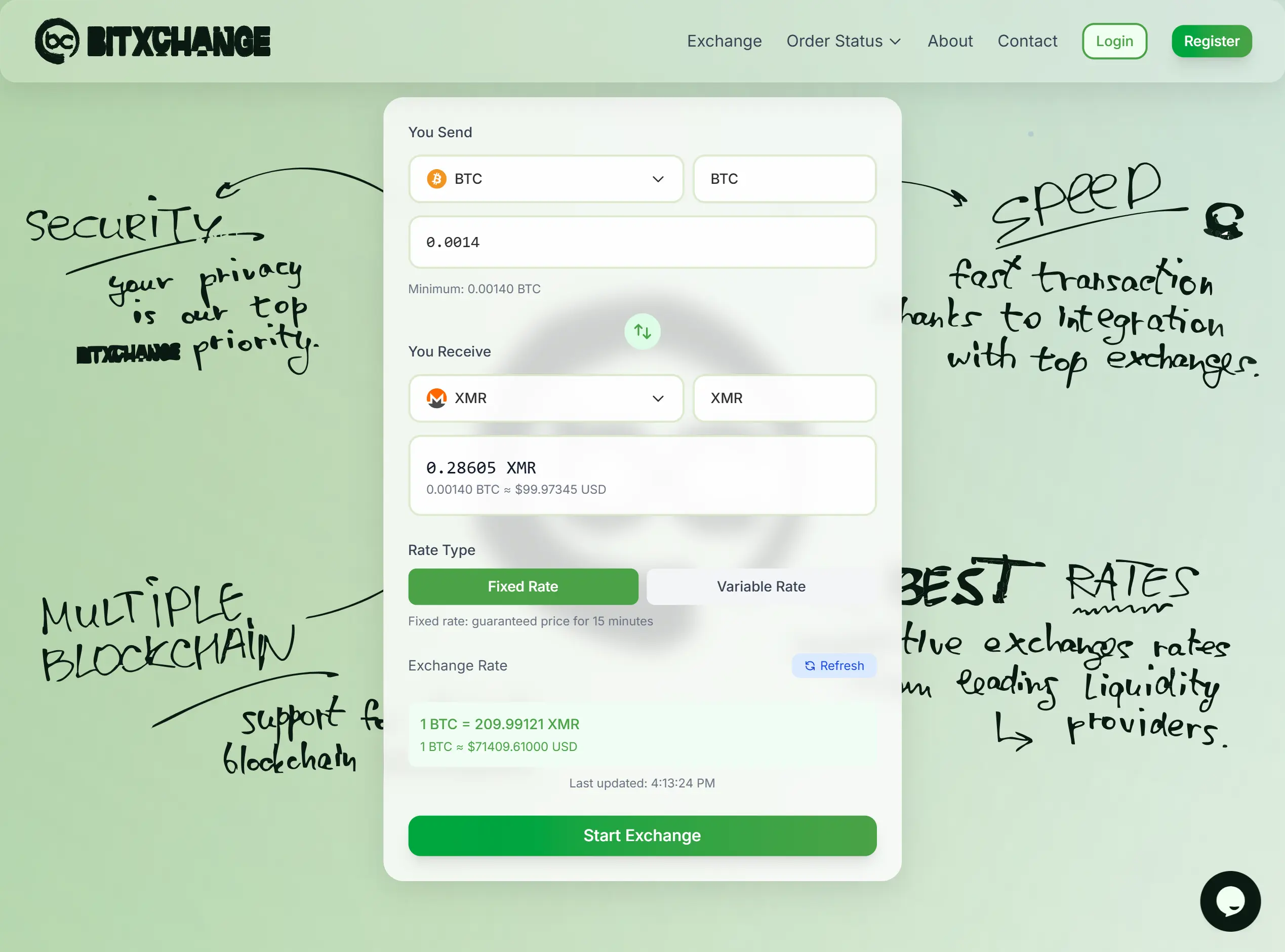
We build centralised crypto exchanges from the ledger up: spot trading on a curated or large set of pairs, real-time order books, deposits and withdrawals across multiple networks, KYC/AML flows, and the admin, owner and partner back offices that let a small team operate the venue. BitXChange, a non-fiat exchange with a large catalogue of pairs, was delivered this way.
Discuss your productWho this is for.
- 01
Founders launching a crypto-to-crypto exchange brand and needing a product that survives investor and partner due diligence
- 02
Brokers, OTC desks and wallet providers adding a trading venue to an existing user base
- 03
Operators replacing a white-label exchange that limits pairs, fees or branding
What's included
- 01
Matching engine with a persistent event log and replayable order books
- 02
Double-entry ledger with idempotent deposits, trades, fees and withdrawals
- 03
Wallet layer: address generation, confirmation tracking, hot/cold separation or custody-provider integration
- 04
KYC/AML onboarding tiers, limits and sanctions screening through a provider
- 05
Real-time market data over WebSockets: order books, trades, candles, tickers
- 06
Trading interface in Next.js with charts, order entry, portfolio and history
- 07
Admin, owner and partner back offices: listings, fees, limits, approvals, reporting
- 08
Security controls: 2FA, withdrawal whitelists, rate limiting, audit logs
How we build it.
An exchange is three systems with very different failure modes: the matching engine must be deterministic and fast, the ledger must never lose or duplicate a balance change, and wallets must survive chain reorgs and operator mistakes. We keep them in separate services with explicit contracts, so each can be tested, scaled and audited on its own. The trading UI consumes a normalised market data stream rather than talking to the engine directly.
- 01
In-memory order book per market with an append-only event log, so the book can be rebuilt after a crash and every trade can be explained
- 02
Balances derived from ledger entries; every external event carries an idempotency key
- 03
Pair configuration as data, so operators list a market without a deployment
- 04
Custody through a provider for the first launch, with a clear path to self-managed wallets later
Scope, timeline and budget.
Ranges are based on recent projects. After a discovery call we send a fixed estimate for the first milestone.
Exchange MVP
- Timeline
- 4–6 months
- Budget
- from 80k USD
Spot trading on a curated set of pairs, provider custody and KYC, admin back office, web trading UI, controlled public launch.
Full platform
- Timeline
- 6–9 months
- Budget
- 150–300k USD
Large pair catalogue, multiple back offices, partner programme, reporting, advanced order types, mobile-ready UI.
Team extension
- Timeline
- ongoing
- Budget
- monthly
Senior engineers embedded in your team to build or modernise specific exchange components.
Frequently asked questions.
01How long does it take to build a crypto exchange?
A crypto-only exchange MVP with provider custody and KYC takes four to six months to a controlled public launch, with internal trading on testnets by month three. Fiat on-ramps, margin products or self-managed custody extend the timeline.
02Do you provide the licence or legal setup?
No. We are engineers and work alongside your legal and compliance advisors. What we do is translate their requirements into technical controls: KYC tiers, limits, monitoring hooks, audit trails and reporting.
03Can you integrate external liquidity?
Yes. We have built market-data and order-routing integrations with external venues and liquidity providers, which is a common way to launch with deep books on day one.
04Will we own the code?
Yes. All source code, infrastructure definitions and documentation are transferred to you; there is no white-label licence or vendor lock-in.
Blog.
Planning something like this?
Tell us what you want to launch and when. An engineer will reply within 24 hours with questions, a draft scope and a realistic estimate.